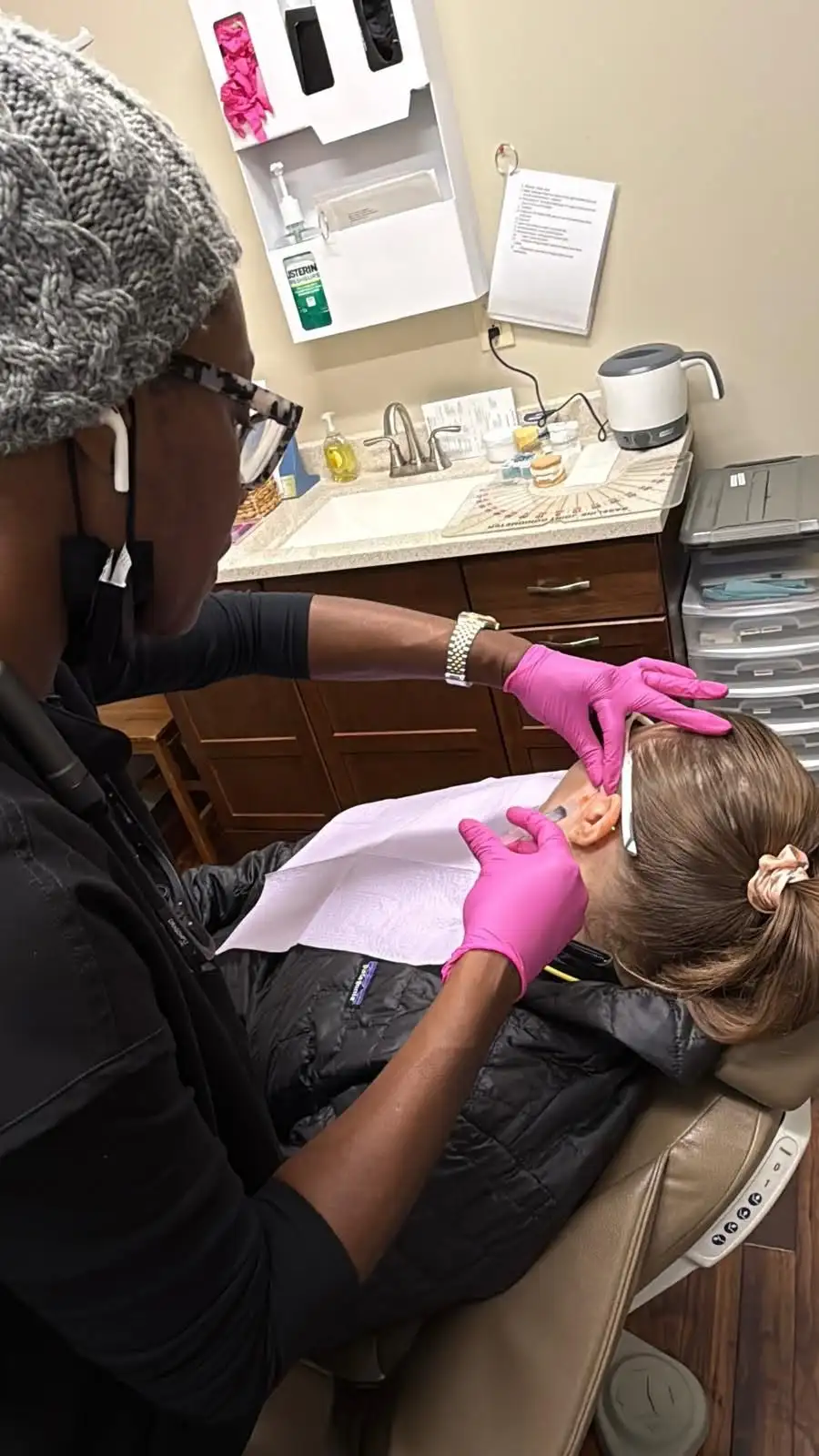
Trigger point injections release the tight jaw, temple and neck muscles behind many TMJ headaches, given by a dentist with a TMD residency and craniofacial pain fellowship.
Dr. Nelly Silva, DMD
A trigger point is a hyper-irritable knot inside a firm, taut band of muscle. In TMJ disorders these knots form in the chewing muscles of the cheek and temple and in the muscles of the neck and shoulders. A knot stays contracted, and it sends pain to places that seem unrelated.
That referred pain is the reason injection therapy belongs in a dental office. Pain in the head and neck often starts somewhere else. A tooth can feel sensitive because the muscle around it is in spasm, not because the tooth has a problem.
During injection therapy, Dr. Silva places a fine needle directly into the knot and delivers a local anesthetic, with or without a steroid. The medication calms the knot so the band of muscle can lengthen and blood can flow back in. Local anesthetic injections into trigger points have been used to manage myofascial pain for many years.
Myofascial pain syndrome links a specific trigger point to a specific pain area. These are the patterns that point us toward the muscles.
A sore, tired jaw, worse after chewing, talking or waking, with tender spots you can press.
Masseter and temporalisHeadaches that wrap around the temples or sit behind the eyes, often in the morning.
Referred from the temple muscleTeeth that ache or react to cold when X-rays and the exam show no decay or cracks.
Muscle spasm near the toothA deep ache near the ear or across the cheek, sometimes mistaken for an earache or sinus pain.
Chewing muscles and jaw jointTight bands in the neck and upper shoulders that feed jaw and head pain on the same side.
Neck and shoulder musclesDaytime clenching or night grinding that keeps the muscles overloaded and the knots active.
Bruxism care alongsideBook a visit if jaw pain, temple headaches or tooth sensitivity keep coming back for more than a few weeks, or if a dental exam for a sore tooth found nothing wrong.
Book NowInjection therapy is one tool in TMJ care. Here is how it compares with two approaches it is often confused with or combined with.
Many patients need more than one approach. Dr. Silva explains which ones fit your exam before anything is scheduled.
The diagnosis is clinical. It depends on a detailed history and a careful, directed exam, so the first visit is about finding the right muscles.
We ask where it hurts, when it started, what makes it worse and how you sleep, chew and clench.
Dr. Silva presses along the jaw, temple and neck muscles to find the knots that reproduce your pain. TENS and K7 readings can show how the muscles are working.
Each identified trigger point is cleaned and injected with a fine needle. The visit is short, and many patients notice the muscle loosen as the anesthetic takes effect.
We show you gentle jaw stretches and heat to keep the muscle relaxed, then check your progress and decide whether a short series is needed.
 Dr. Nelly Silva, DMD
Dr. Nelly Silva completed a TMD Residency through the American Academy of Craniofacial Pain and is a Fellow of the Academy. She is also a graduate of the Las Vegas Institute for Advanced Dental Studies, a postgraduate center for neuromuscular dentistry, so she treats the jaw as a system of muscles, joints and teeth.
She teaches as a Clinical Associate Professor in the Department of Oral and Maxillofacial Pathology, Medicine and Surgery at Temple University's Kornberg School of Dentistry, and she has discussed TMD on CBS 3's American Health Front. She invites patients to call her Nelly.
"Takes time for questions and gives detailed explanations. I felt very comfortable and relaxed."
Lynn M., Google ReviewAn injection calms the knot. Keeping it calm means treating what overloads the muscle in the first place, and we offer that care under one roof.
K7 readings and TENS show how your jaw opens, closes and rests, so we can see when an uneven bite strains the muscles.
When grinding keeps the knots active, an appliance made from a model of your teeth takes the load off the muscles.
Clenching and jaw pain often travel with snoring and sleep apnea. Dr. Silva is a Diplomate in Dental Sleep Medicine.
The cost of injection therapy depends on how many trigger points are treated and whether a series is planned. We review the cost and your benefits with you before treatment begins. We do not accept Medicaid.
Questions patients ask most about trigger point injections for TMJ pain.
Not quite. A trigger point injection usually contains a local anesthetic, and a steroid is added only in some cases. It is placed into a knot in a muscle rather than into a joint or around a nerve, which is where most steroid shots and nerve blocks go.
The needle is fine, and most patients describe a brief pinch or a deep pressure as it reaches the knot. The anesthetic begins working within moments. Many patients feel the muscle loosen before they leave the chair.
It varies with how long the knot has been active and what keeps it going. Some patients need one visit, and others do better with a short series. Stretching, home care and treating clenching or grinding help relief last longer.
Most patients go back to their usual day. We show you gentle jaw stretches to do at home and suggest moist heat on the treated muscle, which helps it stay relaxed. Softer foods and a break from chewing gum for a few days also give the muscle a rest.
Yes. Pain from a muscle in spasm can be felt in the teeth, the ear or the head. When a tooth aches and the exam finds nothing wrong with it, we check the surrounding muscles for trigger points.
No lab or imaging test can show a trigger point. The diagnosis comes from your history and a directed exam. Imaging is still useful for ruling out a problem in the teeth or the jaw joint.
No. Botulinum toxin relaxes a muscle by blocking the nerve signals that make it contract, while a trigger point injection uses a local anesthetic to release a specific knot. They work differently, and Dr. Silva can explain which approaches suit your jaw.
Yes. Patients come to us from Trappe, Royersford, Oaks, Limerick, Skippack, Phoenixville, Norristown and Blue Bell. Our office is at 399 Arcola Road in Collegeville.
One exam can show whether trigger points are driving your jaw pain, headaches or sensitive teeth, and what will calm them.